Other Bridges: Warrington Transporter Bridge
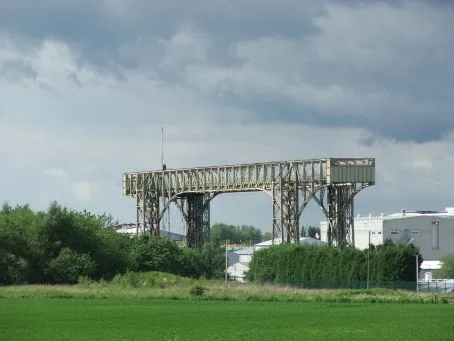
Newport's Transporter Bridge has two surviving sisters in the United Kingdom. One is Middlesbrough's, which is still at work on the Tees. The other stands on the River Mersey at Warrington, where it has been silent for more than half a century. Built for industry rather than for the public, the Warrington Transporter Bridge is a very different kind of structure from Newport's. It is still a fascinating cousin.
A bridge built for a factory
Where Newport's bridge opened in 1906 to carry townspeople, horses, carts and later cars across the Usk, Warrington's was a private industrial link. It served the Bank Quay works of Joseph Crosfield and Sons, the soap and chemical firm whose site lay on both sides of a sharp bend in the Mersey. Land inside the bend, known as Tongue Island, was ideal for expansion, but the tidal river was still used by masted vessels. Any crossing therefore had to be high enough to leave plenty of headroom.
A transporter bridge solved the problem in the same way it had at Newport. A fixed high-level span carries a moving platform, or gondola, which hangs just above the water. Nothing blocks the channel, and no long approach ramps are needed.
Two bridges at Bank Quay
There were in fact two crossings at the site. An earlier, lighter structure was brought into use around 1908 and was designed to move goods across the river. It was later dismantled, and historians often debate whether it counts as a true transporter bridge. The bridge that survives was begun in 1913 and opened in 1916, at a cost of about £34,000. It was designed by William Henry Hunter and built by the renowned Scottish firm Sir William Arrol and Co. Arrol's name is also linked with some of Britain's best-known steel structures.
The bridge in numbers
- Overall length: about 103 metres (339 feet)
- Main span: about 61 metres (200 feet)
- Width: about 9 metres (30 feet)
- Clearance above high water: around 23 metres (76 feet)
- Construction: structural steel on brick plinths
Carrying wagons, not just people
The feature that sets Warrington apart is its gondola. It was designed to take railway wagons, and rails ran right up to the aprons at each end and onto the platform. Materials and finished products could travel between the works and the main railway line without being unloaded. The original design allowed for loads of around 18 tonnes.
The bridge changed with the needs of the works. Around 1940 it was converted so that road vehicles could use it as well, and in the years after the Second World War it was strengthened to carry up to about 30 tonnes. This is why Warrington is often described as the only surviving transporter bridge to have been built for rail traffic. Only one other bridge of that kind is known to have existed, at Kiel in Germany, and it was demolished in the 1920s.
Silence on the Mersey
The bridge stopped working around 1964. Road and rail arrangements had moved on, and the industrial need for a river crossing at this point had gone. Warrington's bridge was not alone in disappearing from use. The Widnes–Runcorn Transporter Bridge, also on the Mersey, was demolished in the early 1960s. Of the four transporter bridges once found in Britain, three are left.
Unlike Newport's bridge, Warrington's gondola cannot take passengers today. The structure is no longer in service, and its steelwork has suffered from decades of exposure and limited maintenance.
Protection and the fight for its future
The bridge has statutory protection as a nationally important historic structure, and Warrington Borough Council now owns it. Even so, its condition has placed it on the Heritage at Risk register. Historic England has noted that the gondola remains intact, but has also said that a long-term solution is needed for its upkeep. A volunteer group, the Friends of Warrington Transporter Bridge, has worked with the local authority to raise awareness of the structure and to provide information for visitors.
The surrounding area has changed dramatically as well. The Crosfield works, a familiar sight to rail passengers passing through Warrington Bank Quay station, ceased large-scale production in 2020, and parts of the former site are being redeveloped. The bridge can be seen from public paths along the river, and it is a striking reminder of the area's industrial past.
How it compares with Newport
Visitors to Newport will recognise the basic idea at once: tall towers, a high girder, and a platform suspended on cables. The differences are instructive, though.
- Purpose: Newport was a public crossing for the town, while Warrington served a single industrial site.
- Cargo: Newport's gondola carried people and vehicles, while Warrington's was also designed to carry railway wagons.
- Status today: Newport's still works and welcomes visitors, while Warrington's stands still.
Why it matters to Newport
Warrington's bridge shows how flexible the transporter idea once was. It could serve a busy town, as at Newport, or a single great works on the Mersey. It also shows how easily such structures can be lost once their purpose fades. Newport's Transporter Bridge, still crossing the Usk and cared for by those who value it, is a reminder of what can be done to keep this rare engineering tradition alive.