Other Bridges: Rouen Transporter Bridge
Newport's Transporter Bridge is one of a small family of structures built to carry traffic across a river without blocking the ships passing beneath. One early relative stood in Normandy. The Rouen Transporter Bridge crossed the Seine for four decades before it was destroyed in the opening weeks of the Second World War. Its story shows where Newport's bridge came from, and why Newport's survival matters.
A new crossing for a busy port
Rouen is an inland port, and ships had to climb the Seine to reach its quays. A fixed low bridge would have shut out the tall sailing vessels that traded there, so the city needed another solution. On 23 September 1895 Rouen decided to build a transporter bridge. Only three other bridges served the two banks at the time.
The design was by the engineer Ferdinand Arnodin, who specialised in suspension and cable-stayed structures. Work began in the autumn of 1897, and the bridge opened on 15 September 1899. It was the second transporter bridge in the world to enter service, after the Vizcaya Bridge in Spain. It linked the Quai Gaston-Boulet on the right bank with the Quai de la Presqu'île-Rollet on the left. For its entire life it was the last bridge over the Seine before the river's estuary.
Design and engineering
The structure
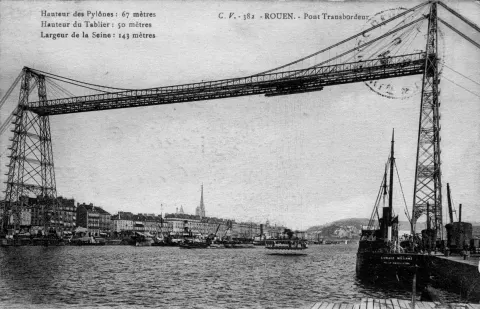
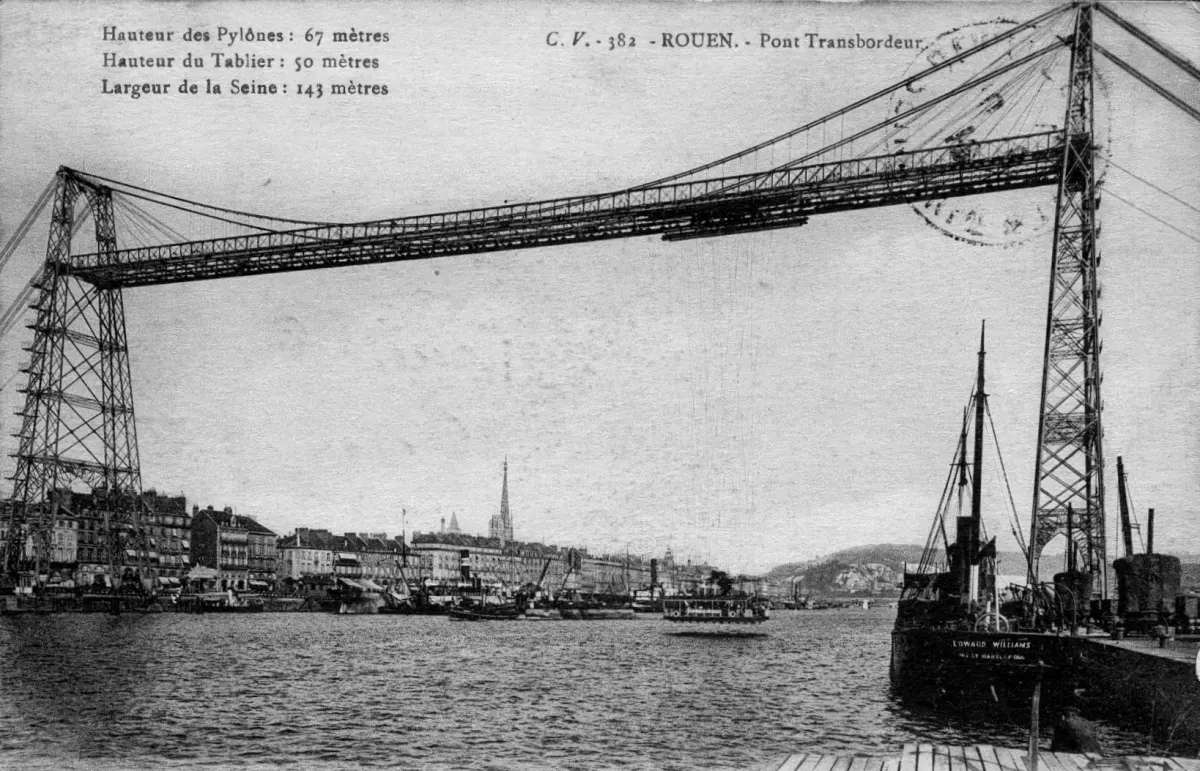
The bridge had a span of 143 metres and stood 70 metres tall. That left 51 metres of clearance for shipping, enough for large sailing ships to pass beneath and reach the maritime quays. Arnodin used a semi-rigid suspended design with a straight, level deck held by stay cables anchored in the ground. He used the same technique for his transporter bridges at Brest and Rochefort.
The bridge carried pedestrians, cyclists and light vehicles. Walkways ran along both sides of the high-level deck, and one was open to the public. It gave walkers a panoramic view of the river and the city.
The gondola
A travelling car ran on wheels along two rails beneath the deck and was driven by two electric motors. The platform covered about 130 square metres and could carry 15 tonnes. A traffic lane ran down the middle, with a weather shelter on each side. One shelter was glazed and fitted with benches for first-class passengers. The other, for second-class passengers, offered standing room only. Over the years the gondola was repainted in several colours, including white, green and later a salmon shade.
Life on the bridge
The bridge was both a working crossing and a local landmark. During the First World War, Arnodin made crossings free of charge as a patriotic gesture.
Its height also attracted daredevils. On 5 May 1912 the aviator Marcel Cavelier flew an aeroplane beneath the structure to win the Claudel Prize. On 29 March 1925 the Polish diver Willy Wolf made a spectacular jump from the bridge.
Service was almost continuous. The main break came between May 1926 and July 1930, when the bridge closed for major maintenance. After that it carried on until the early stages of the Second World War.
Destruction in June 1940
On 9 June 1940 French soldiers blew up the bridge to slow the advancing German army. The demolition happened amid great confusion, and river traffic had not been stopped. As the deck fell, it crushed a tugboat called the Houdon, which was carrying refugees. The vessel sank immediately.
The bridge was never rebuilt. Rouen lost a landmark that had been part of its skyline since 1899.
Rouen and Newport compared
The two bridges share a designer's influence and a basic idea. Each carried road and foot traffic across a tidal, navigable river on a gondola hung from a high girder. That left the water clear for ships.
- Dates: Rouen opened in 1899, and Newport followed in 1906.
- Rivers: Rouen spanned the Seine, while Newport's gondola crosses the River Usk.
- Designer: Rouen was the work of Ferdinand Arnodin. Newport's bridge also came out of his engineering tradition.
- Fate: Rouen's bridge was demolished in 1940. Newport's still carries passengers.
Rouen was also the sort of site Arnodin had in mind: a working port that needed to keep tall masts moving upriver. Newport's docks and the industry around the Usk called for much the same answer.
Why Rouen's lost bridge still matters to Newport
Rouen's bridge is a reminder that these structures were once far more common, and that wartime and changing transport needs removed many of them. Photographs and records of the Rouen bridge show how a transporter bridge worked in daily life, with its gondola, shelters and walkways.
Newport's Transporter Bridge, opened in 1906, still crosses the river and still draws visitors, enthusiasts and film-makers. It is now a rare working example of a design that Rouen helped to pioneer. Looking at the Normandy bridge helps Newport see how much its own bridge is worth protecting.