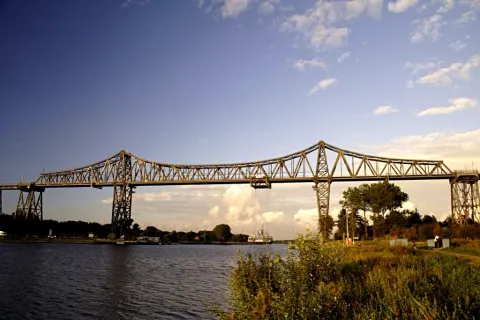
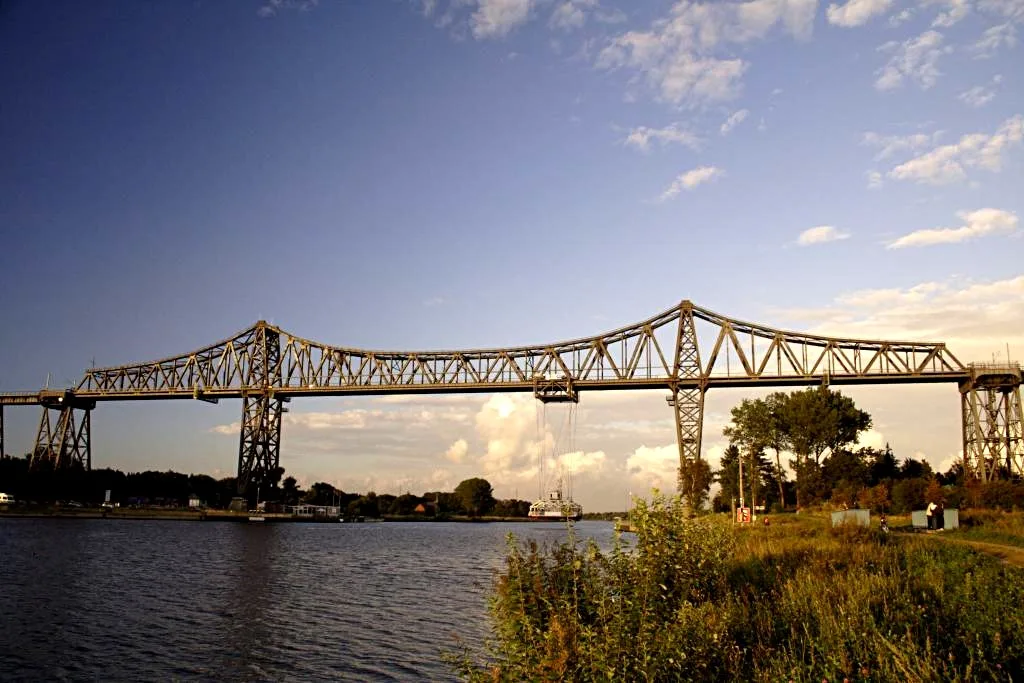
Other Bridges: Rendsburg High Bridge
Newport's Transporter Bridge may be one of only a handful of its kind, but it is not alone. In northern Germany, high above the Kiel Canal, stands a structure that does something Newport's does not: it carries a main-line railway on its upper deck while a gondola swings from its underside. This is Rendsburg High Bridge, and it makes a fascinating comparison for anyone who loves the Usk crossing.
A railway bridge with a second job
Rendsburg High Bridge, known in German as the Rendsburger Hochbrücke, is a steel railway viaduct on the line between Neumünster and Flensburg in the state of Schleswig-Holstein. It crosses the Kiel Canal at the town of Rendsburg and is owned by the federal government through the authority that runs the canal.
Its transporter element is a suspended ferry, called a Schwebefähre in German. The gondola hangs from a carriage that runs along rails fixed beneath the main span, so it crosses the water without ever touching it. Few structures anywhere combine the two functions, which is why Rendsburg is often singled out among the world's Transporter Bridges.
Why it was built
The Kiel Canal, originally the Kaiser-Wilhelm-Kanal, was dug between 1887 and 1895. It cut across existing routes, including the railway between Neumünster and Flensburg, and two swing bridges were built to carry the trains. When a train was due, ships on the canal had to stop and wait. That cost time for every vessel, and the navy was especially concerned that closed bridges could hold up whole flotillas for hours.
In 1907 it was decided to enlarge the canal and remove its major obstacles. The answer at Rendsburg was to lift the railway high enough that ships could pass beneath without interruption.
Engineering the climb
The design is credited to Friedrich Voss, and the bridge was built between 1911 and 1913. It gives a clearance of 42 metres above the canal's mean water level. Because the original tracks crossed only about seven metres above the water, the railway had to be raised by roughly 36 metres. Trains cannot climb steeply, so the gradient had to stay very gentle. That demanded long embankments and approach bridges on each side, and the whole structure runs to about 7.5 kilometres.
Key figures
- Steel viaduct length: 2,486 metres
- Cantilever main bridge: 317 metres long
- Longest span: 140 metres
- Height: 68 metres
- Construction cost: 13.4 million Mark, including the relocation of railway lines
The Rendsburg Loop
Rendsburg station sits at ground level only a short distance from the main bridge. To connect it with the elevated line, the railway makes a full 360-degree loop on the north bank of the canal. It is a distinctive feature that railway enthusiasts still seek out.
The gondola beneath the span
The suspended ferry entered service on 2 December 1913. It provides the shortest link between Rendsburg and the neighbouring community of Osterrönfeld, which lost its direct connection when the canal was built. In its working life the original gondola carried around 350 cars and 1,700 people on a typical day, including many pedestrians and cyclists. The crossing is only about 120 metres and takes under two minutes.
The ferry has had its share of drama. In January 1993, during a storm, the unmanned gondola's brakes failed to hold against the wind and it rolled out towards the middle of the canal, striking a ship's mast and crane. Damage was minor. A far more serious accident came on 8 January 2016, when the gondola collided with a cargo ship. It was so badly damaged that it could not be repaired.
A new gondola for a historic bridge
Rather than abandon the crossing, the authorities commissioned a replacement built to look like the original but equipped with modern drive and safety systems. After a construction period of nearly three years, the new gondola formally entered service on 4 March 2022. It carries up to 100 people and four vehicles, and is driven by four electric motors. The rails and rail supports on the high bridge were renewed at the same time.
The rebuilt ferry has not been free of teething troubles. It was taken out of use in March 2025 after cable damage caused a short circuit, and further faults found during investigation meant a long programme of mechanical and electrical work. It returned to service on 21 November 2025. As the operators noted, the ferry is a one-off, and its many components from different manufacturers all have to work together perfectly.
Officials describe it as one of the last eight structures of its type still in existence worldwide, out of about 20 that once existed.
What Rendsburg tells us about Newport
Newport's Transporter Bridge opened in 1906, a few years before Rendsburg's ferry was hung beneath its viaduct. Both bridges were born of the same problem: how to cross a busy navigable waterway without blocking the ships that used it, and without the cost of very long approach ramps. Both have also faced the challenge of keeping a rare, specialised piece of machinery running long after its builders' time.
Rendsburg's decision to replace its damaged gondola, rather than let the crossing go, shows how highly such structures are valued by the communities they serve. It is a message that resonates in Newport, where the bridge remains a much-loved landmark and a reminder of the town's industrial pride. Seeing how a sister bridge in Germany is cared for helps put Newport's own treasure in its worldwide context.