Other Bridges: Puente Nicolás Avellaneda
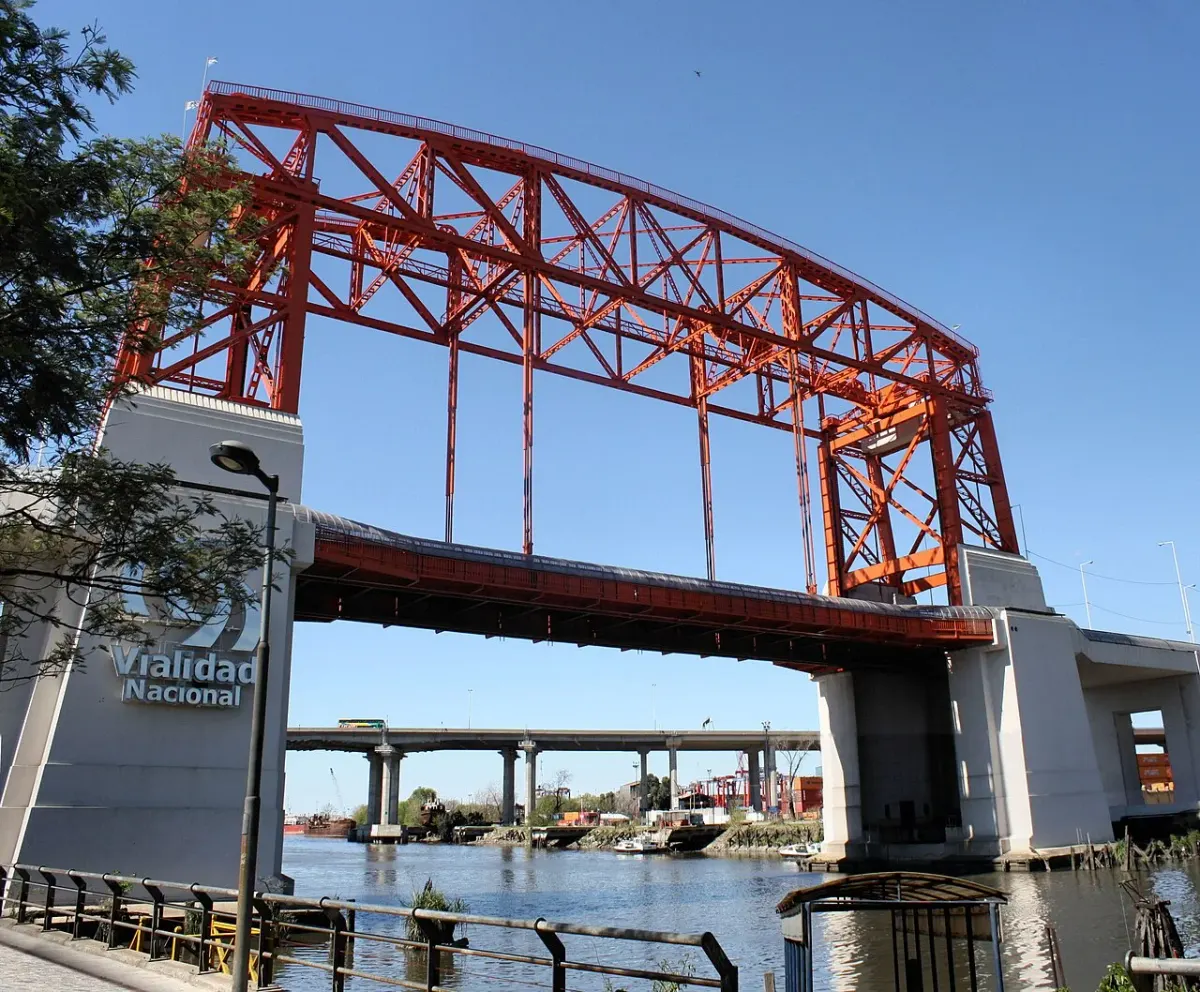
Most visitors to Newport know the Transporter Bridge as a one-of-a-kind sight on the River Usk. Look further afield and you will find some unusual relatives. One of the oddest is the Puente Nicolás Avellaneda in Buenos Aires. It is a road bridge with a lifting span, and it also carries a Transporter gondola, a combination found almost nowhere else.
A lift bridge over the Riachuelo
The Puente Nicolás Avellaneda crosses the Riachuelo, the small river that marks the southern edge of the Argentine capital's federal district. It is a two-lane road bridge about 1,650 metres long, including its long approach ramps. Construction ran from 1937 and the bridge was completed in 1940.
The centre of the structure is a vertical lift span. Two steel towers stand either side of the channel, and the deck rises between them on a system of chains and counterweights driven by electric motors. Engineering records name Juan Agustín Valle as the engineer and Eduardo Rodríguez Videla as the architect.
The key figures
The lifting section rises about 57 metres above the water at the top of its towers. Published sources give its length as roughly 60 to 65 metres. The span has two settings:
- Lowered: about 21 metres of clearance for vessels passing below.
- Raised: about 43 metres of clearance, enough for much taller ships.
This matters because the Riachuelo has long been a working waterway lined with docks, yards and industry. Any crossing had to allow shipping through, which is the same problem that led Newport to choose a Transporter Bridge in the early 1900s.
The gondola that sets it apart
The lifting section also carries a gondola, so the bridge can work as a Transporter Bridge as well as a lift bridge. This is the feature that has earned it a place among the world's Transporter bridges. It is often described as the only lift bridge anywhere to be fitted with a gondola.
The reason was practical. Horse-drawn wagons were still in use when the bridge was planned, and the long climb up and down the approach ramps was hard going for the animals. The gondola let them cross the river at water level instead.
Motor traffic soon made the gondola unnecessary. Since about 1960 it has been used only when the roadway is closed for maintenance. For most of its life it has simply parked beside the span as a reminder of the original thinking behind the design.
Not to be confused with its neighbour
The name causes some confusion. Barely 100 metres away stands the Puente Transbordador, a separate and older Transporter Bridge. It is also known as the Transbordador del Riachuelo or the Puente Transbordador Nicolás Avellaneda. The two bridges honour the same man, a former president of Argentina.
The older bridge was authorised in 1908 and opened on 31 May 1914. Its steel truss carries a platform measuring 8 by 12 metres. It was designed for pedestrians, carts, cars and trams, and it linked the La Boca district of Buenos Aires with Isla Maciel on the far bank. It was in service until 1960, after which it was out of use for many years. It was declared a National Historic Monument in 1999. It was restored and reopened to the public in September 2017, after 57 years.
The lift bridge arrived in 1940 and took over the heavy lifting of daily traffic. Seen from the water, the two structures stand side by side. One is a graceful early Transporter Bridge. The other is a later, more conventional piece of civil engineering, with the gondola as its unusual extra.
How it compares with Newport
Newport's Transporter Bridge opened in 1906, eight years before the Buenos Aires original. It also solved the problem of crossing a busy tidal river without blocking the ships that used it. In Newport the gondola was the whole point of the design and has stayed at the heart of the bridge's story. In Buenos Aires the gondola was an add-on to a lifting span, and it faded from daily use.
The comparison shows how varied the idea became. Some towns built a Transporter Bridge from scratch. Others adapted it, mixed it with other types or retired it. Because so few were ever built, each one is worth knowing about.
Why it matters
The Puente Nicolás Avellaneda is not a Transporter Bridge in the classic sense, but it belongs to the same family and shows how long the idea stayed alive. For Newport enthusiasts it is a useful reminder that the Usk crossing is part of a small worldwide group of structures. It is a group that is easy to overlook and well worth protecting. Each surviving example helps explain why Newport's bridge deserves its pride of place.