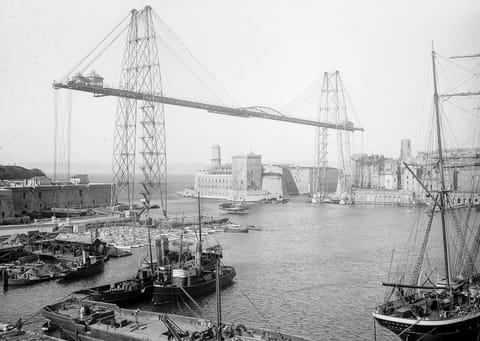
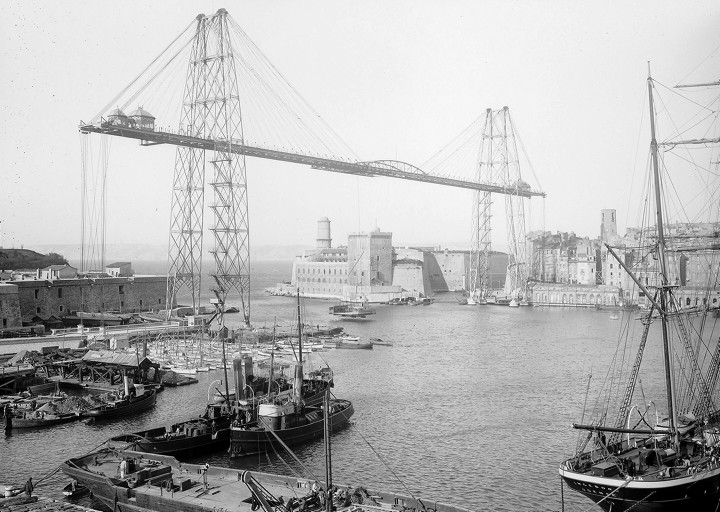
Other Bridges: Marseille Transporter Bridge
Long before Newport's Transporter Bridge became a much-loved landmark on the River Usk, another Transporter Bridge dominated the skyline of a famous Mediterranean harbour. The Marseille Transporter Bridge crossed the Old Port, opened in 1905 and was destroyed during the Second World War. It is one of the great lost structures of its kind, and it shares a designer with Newport's own bridge.
A giant above the Old Port
The bridge spanned the entrance to the Old Port of Marseille, the historic harbour at the foot of the city's main street, the Canebière. It linked the quays on either side of the harbour mouth, with the Rive Neuve on the southern side. Because the deck was carried high above the water, ships could sail beneath it without interruption, which was the whole point of the transporter bridge idea.
The designer was the French engineer Ferdinand Arnodin, who is widely credited with developing the transporter bridge. Arnodin had already built similar crossings elsewhere in France, and Marseille was among the most ambitious. He held the concession to build and run the bridge, and the work is generally described as having been financed by his own enterprise.
Built in nineteen months
Construction moved quickly. The bridge was completed in just nineteen months and was inaugurated on 15 December 1905. Some engineering records give a slightly later date in December for its completion, but 1905 is agreed on all sides.
Its scale was impressive. Two steel towers, each a little over 86 metres tall, carried a deck of roughly 239 metres. That deck stood about 50 metres above the water. Each tower was said to weigh around 240 tonnes. For a harbour city proud of its maritime trade, it was a bold piece of modern engineering placed right in the heart of the old town.
The gondola
As at Newport, the crossing was made by a gondola hung from the high deck rather than by a deck-level ferry. The Marseille gondola had an area of about 120 square metres and weighed around 20 tonnes. It made the trip between the two banks in roughly a minute and a half, carrying passengers and vehicles across the harbour mouth without disturbing the shipping below.
A restaurant in the sky
The bridge was more than a crossing. Visitors could climb to the high walkway, and accounts describe a viewing platform and a restaurant at the top. Diners could enjoy local seafood, including bouillabaisse, while looking out over the harbour and the Mediterranean. In that sense the bridge was both a piece of transport infrastructure and a popular attraction, much like a modern landmark that draws visitors who simply want the view.
Decline and destruction
The bridge did not enjoy a long working life. By the 1930s there was too little money to keep it properly maintained, and it was seen more as a picturesque backdrop than a working crossing. It was closed to traffic in 1940 with the outbreak of war.
The end came during the Liberation of Marseille. On 22 August 1944, German forces blew up the bridge in an attempt to block the harbour. Only the north tower fell into the water at that point. The rest of the structure remained standing for a time, until it was brought down on 1 September 1945 by a charge of about 400 kilograms of explosives. It had stood for less than forty years.
An image that outlived the bridge
Although the bridge is gone, it survives in photographs, postcards and film. The Hungarian artist László Moholy-Nagy was fascinated by it. He photographed it, and it features prominently in his short film about the Old Port of Marseille. He described it as a marvel of technical precision and beauty, a reminder that industrial structures could be admired as works of art as well as feats of engineering.
Why Marseille matters to Newport
Marseille and Newport belong to the same small family. Arnodin's designs produced a handful of transporter bridges around the world, and Newport's opened only a few months after Marseille's, in 1906. The two were conceived to solve the same problem: how to carry people and vehicles across a busy waterway without blocking the ships that used it.
The difference lies in what happened next. Marseille's bridge was lost to war and never rebuilt, so only images and records remain. Newport's bridge survived the twentieth century and still carries its gondola across the Usk today. That makes it a rare survivor of a design once admired in major ports. When Newport people look at the old pictures of the Old Port, they are seeing what might have been lost here too, and why the care of the Newport Transporter Bridge is worth the effort.