Other Bridges: Buenos Aires' Transporter Bridge
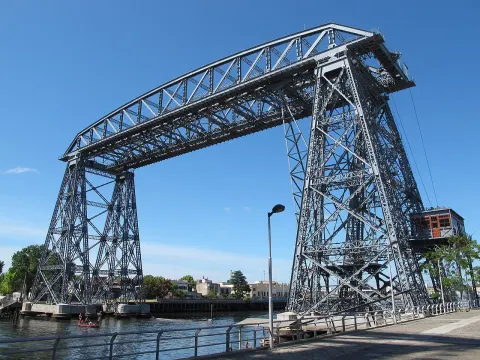
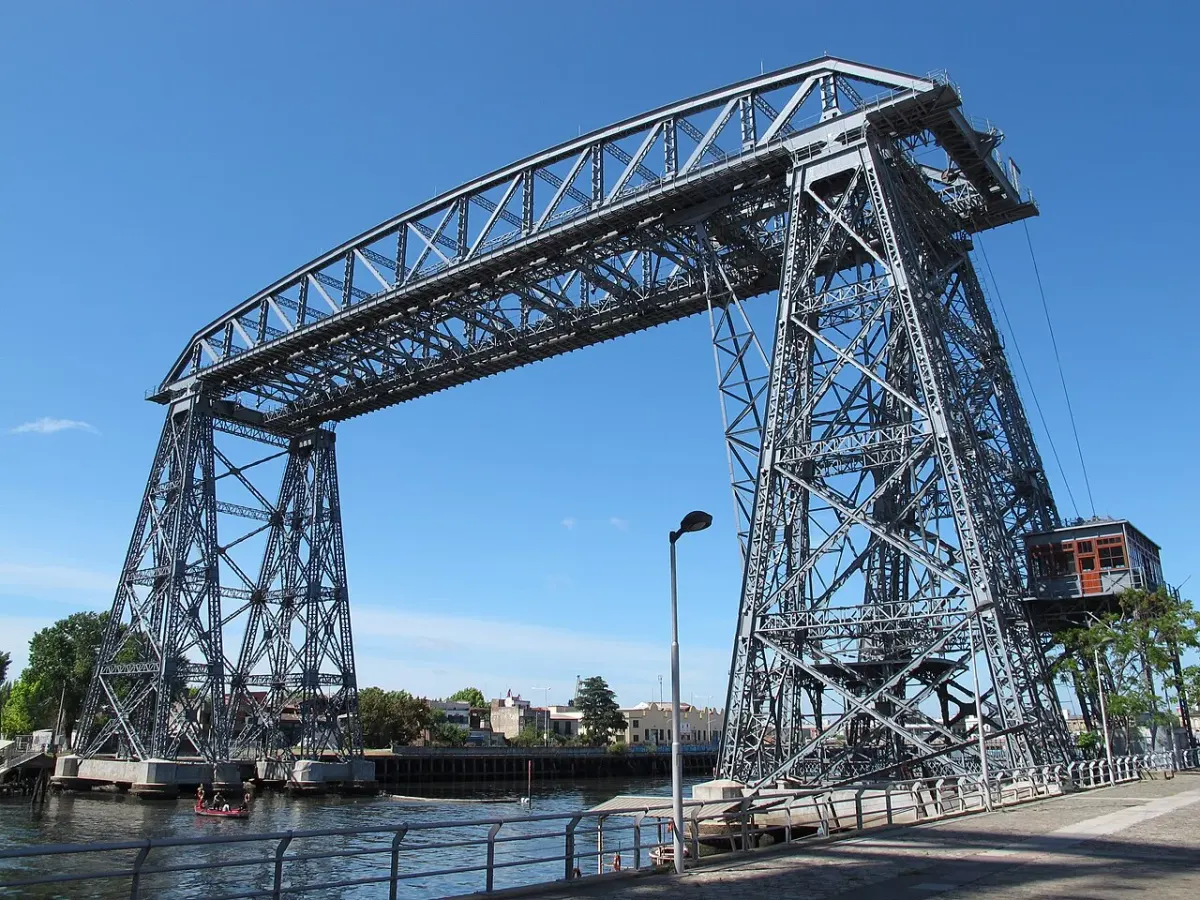
Newport's Transporter Bridge has relatives in several countries. One of the most striking stands in the South American capital. The Puente Transbordador crosses the Riachuelo River in Buenos Aires. Like Newport's bridge, it uses a suspended gondola to carry people and vehicles over a busy waterway without blocking the ships that use it. Its story has a long silence in the middle and a hopeful ending, and that makes it worth knowing for anyone who loves the Usk crossing.
A bridge with many names
The structure goes by several titles. It is called the Buenos Aires Transporter Bridge, the Puente Transbordador de La Boca and the Transbordador del Riachuelo. It is also known as the Puente Transbordador Nicolás Avellaneda, and sometimes as the Antiguo Puente Nicolás Avellaneda, meaning the old Avellaneda bridge. The name honours Nicolás Avellaneda, a former president of Argentina, who also gave his name to the Avellaneda district on the opposite bank of the river.
Where it stands
The bridge links two very different neighbourhoods. On one side is Avenida Almirante Brown in La Boca, the colourful, port-side district of Buenos Aires. On the other is Avenida La Plata on Isla Maciel, part of Dock Sud. At the time it was built, it was the first link connecting the city with the outlying communities across the Riachuelo. That made it a practical lifeline for workers, traders and travellers as well as an engineering showpiece.
Construction and opening
The project began on 25 September 1908, when the Buenos Aires Great Southern Railway was authorised to build a transporter bridge. It would join the city with Buenos Aires Province, to the south of the river. The province paid the full cost, even though the capital was also a beneficiary. The bridge was inaugurated on 31 May 1914, some eight years after Newport's own Transporter Bridge opened in 1906.
Design and the gondola
A steel truss
The bridge is a truss structure, with a high steel framework rising above the water to leave room for river traffic below. A platform, or gondola, hangs from this framework and travels across the river.
Built for a mixed load
The platform measures 8 metres by 12 metres. It could be controlled from a stand on the platform itself or from the machine house on the bank. It was designed to carry pedestrians, carts, cars and even trams, a reminder of how varied city traffic was in the early twentieth century.
Years of service and silence
The bridge worked from 1914 until 1960. A larger road bridge, the Puente Nicolás Avellaneda, had been completed in 1940 only about 100 metres away. Its high spans let motor traffic cross without a ferry-style journey, so the older Transporter Bridge gradually lost its role. After 1960 the gondola stopped running, and the bridge stood unused for decades.
The road bridge is unusual in its own right, because it also has a transporter gondola. That gondola is used only when the roadway is closed for maintenance. The two structures now stand side by side as a pair of very different solutions to the same river crossing.
Recognition and restoration
Although it no longer carried passengers, the old bridge was not forgotten. In 1999 it was declared a National Historic Monument of Argentina, which recognised its value as part of the country's industrial heritage. Plans to restore it had been announced in 1997, at an estimated cost of US$1.2 million.
The work took years to come to fruition. In September 2017 the bridge was restored and reopened to the public for the first time in 57 years. Local residents were offered an early crossing, which seemed fitting for a structure that was built to serve the neighbourhoods on either bank.
Seen today
Today the bridge is more a landmark than a commuter route. Its steel frame stands out against the Riachuelo, and the modern Nuevo Puente Pueyrredón rises in the background. Historic photographs show how much its surroundings have changed. They include images of the gondola loaded with passengers and cars in the 1930s and of people boarding in the same decade. Others show the bridge at work in 1951. Together they give a vivid picture of everyday life on the river.
Why it matters to Newport
Transporter bridges are among the rarest types of large bridge in the world. Each surviving example shows a different answer to the same problem: how to cross a wide, navigable river without a very long approach or a bridge that must open. The Puente Transbordador shows what can happen when a community decides that an idle bridge is worth saving. After more than half a century without use, it carried people again.
For Newport, that is an encouraging example. The Transporter Bridge over the Usk is a much-loved symbol of the city and a rare working survivor. The story from Buenos Aires underlines why such structures deserve care, and why people travel to see them and ride in the gondola. Together, these distant cousins form a small but remarkable worldwide family.