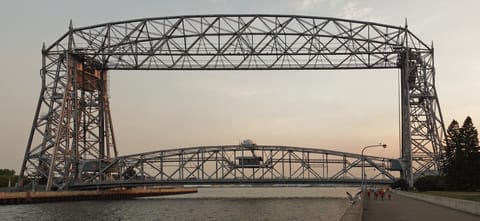
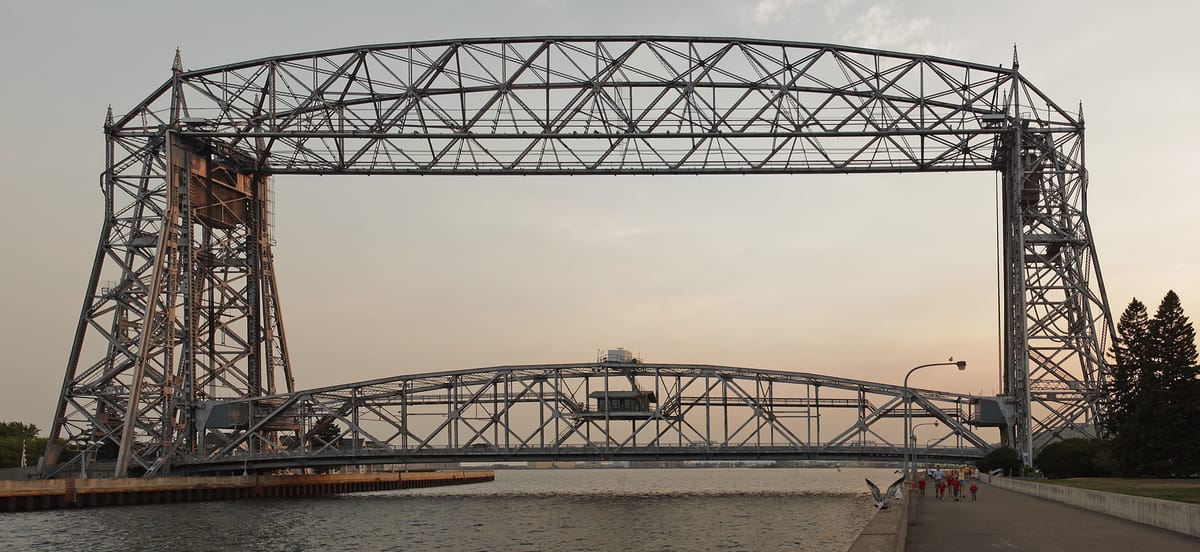
Other Bridges: Aerial Lift Bridge, Duluth, Minnesota
On the shore of Lake Superior, the Aerial Lift Bridge is the symbol of Duluth, Minnesota. Visitors who know the Newport Transporter Bridge will find that it has a familiar story. It opened in 1905, a year before Newport's, as a Transporter bridge with a suspended gondola. It later took a very different path, and it is still in daily use.
A canal that cut off a community
The bridge crosses the Duluth Ship Canal. The canal was cut through Minnesota Point, a long sand spit that locals call Park Point, in 1870 and 1871. The cut gave ships direct access to the harbour. It also turned the neighbourhood on the point into an island, and its residents needed a reliable way across.
Several solutions were tried, and each had problems. Ferries worked well enough in summer but struggled when ice formed. A swinging footbridge was used for a time, but it was widely thought to be flimsy and unsafe. Duluth needed something permanent that would not get in the way of the shipping the canal was built to serve.
A failed design and a new idea
In 1892 the city held a competition for a solution. The winner was John Low Waddell, who proposed a tall vertical lift bridge. Duluth was keen to build it, but the War Department objected and the scheme was dropped. Waddell's idea was not wasted. A version of it was built in Chicago as the South Halsted Street Bridge, which was removed in 1932.
Attention then turned to the Transporter bridge, a type that carries traffic across on a gondola hung from a high girder. The first successful example was the Vizcaya Bridge at Bilbao in 1893. Duluth took its inspiration from a French bridge, although the construction was quite different. The design was prepared by the city engineer, Thomas McGilvray.
The 1905 Transporter bridge
When it was completed in 1905, Duluth's bridge was the first of its kind in the United States. Only one other Transporter bridge was ever built in the country: the Sky Ride, which was part of the 1933–34 Chicago World's Fair and was dismantled after two years.
The Duluth gondola could carry 60 short tons, equal to about 54 tonnes. That was enough for around 350 people, along with wagons, streetcars or early motor vehicles. A crossing took about a minute, and in the busiest parts of the day the car set off every five minutes.
Why it did not last
The gondola soon struggled to keep up. The population of Park Point grew, motor vehicles became more common and visitors increased in number. A ferry that moves one load at a time has a natural limit, and by the 1920s the bridge was working at that limit.
Conversion to a lift bridge
The answer was to rebuild the structure rather than replace it. In 1929–1930 the gondola was removed and a lifting roadway deck was fitted between the towers. The towers were made taller and the original steelwork was kept. The redesign is credited to the engineer C.A.P. Turner, and it echoed Waddell's rejected plan from nearly forty years earlier.
The new deck can be raised to roughly 135 feet (about 41 metres) above the water, which lets large lake freighters pass beneath it. The converted bridge first lifted for a vessel on 29 March 1930. It has worked continuously since then.
The bridge today
The Aerial Lift Bridge carries Lake Avenue over the canal, and it is owned and maintained by the City of Duluth. It is about 153 metres (502 feet) long and carries a roadway about 7.3 metres wide. The bridge was added to the National Register of Historic Places on 22 May 1973.
It is still the main route between Canal Park and Park Point, and it lifts thousands of times a year. Watching a ship pass beneath the raised deck is one of the most popular things to do in Duluth. The nearby maritime museum run by the United States Army Corps of Engineers adds to the visit.
What Duluth means for Newport
The two bridges show how differently the Transporter idea could turn out. Duluth chose to convert its bridge when traffic outgrew the gondola, and that is why it is now a lift bridge. Newport kept its gondola, which still carries people and vehicles across the River Usk. Duluth's bridge was one of the first of the type, and Newport's, opening in 1906, is among the best preserved.
Both bridges are proud landmarks that their communities have chosen to look after. For anyone interested in Newport's Transporter Bridge, Duluth is a good reminder of what makes ours special. It is the real thing, still working, and it is still part of daily life in the city.