How the Transporter Bridge Gondola Crosses the River Usk
Few sights in Newport are as distinctive as the gondola of the Transporter Bridge gliding across the River Usk, suspended high above the water and just clear of the tide. Since 1906 this simple-looking platform has carried people, bicycles and vehicles between the two banks, and the way it works remains a source of fascination for locals and visitors alike.
Why a gondola instead of a conventional bridge?
The answer lies in the river itself. The Usk at Newport has a very large tidal range, and in the early twentieth century it was a busy waterway with ships heading to and from the docks. A low bridge would have blocked shipping. A fixed high-level bridge would have needed long, gently sloping approach roads, and these would have swallowed up valuable land on both banks in a densely built-up area.
The transporter design solved both problems. By lifting the structure that carries the road traffic well above the masts of passing vessels, and then hanging a moving platform beneath it, the designers could keep the river clear and keep the approaches short. The Transporter Bridge was designed by the French engineer Ferdinand Arnodin, who had pioneered the type, and it was opened on 12 September 1906.
How the system works
The high-level girder
The most visible part of the bridge is the pair of tall towers connected by a high-level girder spanning the river. This girder is not a roadway. Instead, it acts as a track, and it is supported by the towers and by a network of strong steel cables. It carries the weight of the equipment that moves along it, and it must remain stable in all kinds of weather.
The travelling carriage
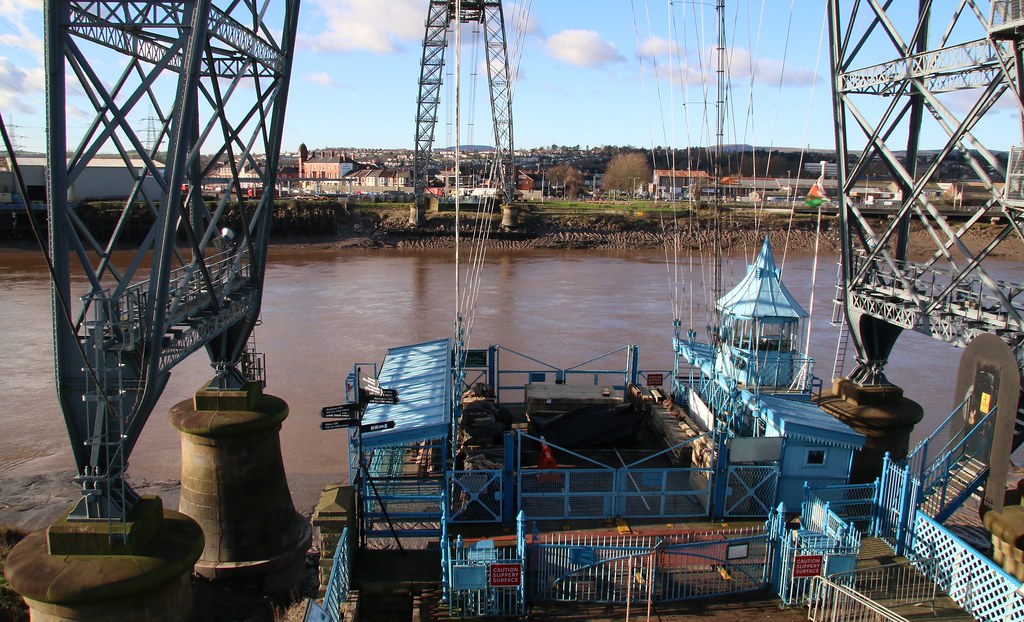
Running along the underside of the girder is a wheeled carriage, sometimes described as a trolley. It rolls back and forth along the span, driven by a system of cables and powered by electric motors. Because the carriage does the heavy work from above, nothing on the riverbed or in the water is needed to move the gondola.
The suspended gondola
Hanging from the carriage on strong suspension cables is the gondola, a flat deck that sits only a short distance above the surface of the water. It is built to take vehicles and foot passengers together, and it is aligned with the road level at each side of the river so that traffic can drive or walk straight on and off. An operator controls the movement, starting and stopping the carriage so that the deck settles precisely at each landing point.
The crossing itself
A journey on the gondola is a short, smooth experience. Passengers and vehicles board at the landing, the deck is secured, and the carriage begins to move along the girder above. The gondola travels steadily across the river, and the whole crossing takes only a few minutes. Because the platform is so close to the water, riders get an unusual view of the river, the banks and the structure towering overhead.
The movement is gentle, with no steep gradients, and that is part of the design's appeal. Traffic enters at one level and leaves at the same level, with the engineering above doing all the lifting and pulling. It is a very different way of crossing a river from anything most people encounter in daily life.
Coping with tide and weather
One of the great strengths of the transporter principle is that the gondola is indifferent to the state of the tide. Whether the Usk is full or reduced to a channel between broad mudbanks, the deck travels at the same height, and the road connections remain constant. That reliability mattered greatly to a port town.
Wind is a more serious consideration for any structure of this kind. A suspended platform can be affected by strong gusts, and the bridge's operation has to respect conditions on the day. Maintenance of cables, rails, motors and the steelwork is also an ongoing task, which is why periods of repair and restoration have occasionally interrupted crossings over the decades. Anyone planning a visit is best advised to check current operating information from the bridge's official sources.
A working piece of heritage
The Newport bridge is one of a small number of transporter bridges around the world that survive, and fewer still remain capable of carrying passengers. Its status as a protected historic structure reflects both its engineering interest and its place in local memory. Generations of Novoportans have used the gondola to get to work, to school or to see family, and others have simply made the trip for the thrill.
Why it still matters
The gondola is more than a quaint survivor. It shows how an ingenious solution to a practical problem can become a lasting symbol of a place. For Newport, the Transporter Bridge speaks of the town's industrial confidence at the start of the twentieth century, and the sight of the gondola crossing the River Usk continues to give the town a skyline, a story and a sense of pride unlike any other.