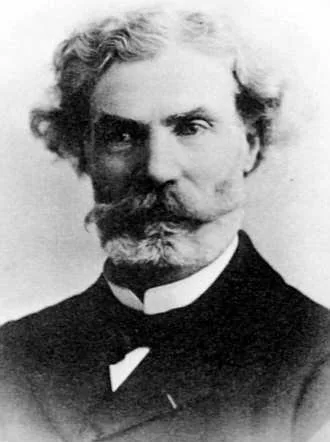
Ferdinand Arnodin: the French Engineer Behind Newport's Bridge
Every visitor who watches the gondola glide across the River Usk is seeing the work of a Frenchman who never lived in Wales. Ferdinand Arnodin was a cable specialist and industrialist whose ideas shaped a small family of remarkable bridges across Europe and North Africa. Newport's Transporter Bridge is one of the finest survivors.
From Lyon to the Loire
Ferdinand Joseph Arnodin was born on 9 October 1845 at Sainte-Foy-lès-Lyon, in the Rhône region of France. His father worked for the firm founded by the bridge pioneer Marc Seguin, which built metal suspension bridges, and the young Arnodin followed him into the business. He studied at Orléans and then Paris before joining the company as an inspector.
He later settled at Châteauneuf-sur-Loire, near Orléans, and it was there that he established the works that carried his name. He died in the same town on 24 April 1924, aged 78. The Loire riverside community remembers his factory to this day.
A new way of making suspension bridges
In 1872 Arnodin set up his own business. His aim was to revive suspension bridge building in France, and he did so with a method that became known as the Système Arnodin. It involved strengthening and stiffening suspension bridges, often by adding stay cables that radiated from the towers.
The twisted cable
In 1874 he devised a new kind of cable made of wire wound in layers, with each layer twisted in the opposite direction to the one beneath. The idea was to produce a rope that was strong, flexible and durable. It was first used on the Saint-Ilpize bridge over the River Allier in 1879. Arnodin went on to build many suspension bridges and to rework older ones, replacing their ageing cables and reinforcing their decks.
Inventing the transporter bridge
Arnodin's name is most closely linked with the transporter bridge. The problem was a familiar one in busy ports. A conventional bridge had to be high enough for tall ships to pass beneath, which meant long approach ramps, while a low bridge would block shipping. A transporter bridge solved both problems. A high girder carries a travelling car, or gondola, which hangs just above the water and carries people and vehicles from bank to bank.
In 1887 Arnodin patented a transporter bridge system, working with the Spanish engineer Alberto de Palacio. Their first completed bridge was the Vizcaya Bridge, which links Portugalete and Getxo on the Nervión estuary near Bilbao and opened in 1893. Palacio is credited with its design and Arnodin with the cable expertise and construction. It is widely regarded as the oldest bridge of its kind.
Arnodin's bridges
Arnodin's company went on to design or build a string of transporter bridges, particularly in France. They included Rochefort-Martrou on the Charente, which opened in 1900, and others at Rouen, Nantes, Marseille and Brest, with another at Bizerte in Tunisia. The Rouen bridge is noted as the first of its type to use electric motors. Sources credit him with around half of the eighteen or so known transporter bridges, and only a handful of those survive.
His work was recognised in France. He was made a Knight of the Legion of Honour in 1890 and an Officer in 1912.
Arnodin and Newport
Newport needed a way across the Usk below the town without hindering the river traffic, and without building a vast bridge with long ramps over low-lying banks. Arnodin was already known as an expert in suspension structures, and he was commissioned to design the crossing. Design work took place in 1901, and the engineer Robert Henry Haynes is recorded as working alongside him. A contract was let in 1902, and construction continued until 1906.
The bridge combines suspension cables with oblique stay cables running from the tops of the towers, a hallmark of Arnodin's transporter designs. He also planned it to be maintained, with cables that could be replaced over time. That foresight paid off, because the main suspension cables were renewed in a refurbishment programme in the 1990s.
Testing the bridge
Before the bridge opened, load tests were carried out between 29 August and 5 September 1906. Arnodin supervised them. Weights were applied to the gondola while the stresses in the cables were measured, using a technique he had written about that involved a small "witness cable" hung alongside the main one. The Viscount Tredegar opened the bridge on 12 September 1906.
Why Arnodin still matters in Newport
More than a century later, the bridge remains a working crossing and a Grade I listed structure. It is a rare example of a type of engineering that flourished briefly and was then largely overtaken by fixed crossings. Its form owes a great deal to one man's belief that cables could do more than anyone had asked of them.
For Newport, Arnodin's legacy is both practical and personal. The Transporter Bridge is part of the city's skyline and identity, and a link with the pioneering Engineers who built it. Each time the gondola sets out across the Usk, a piece of Lyon-born ingenuity is still at work.